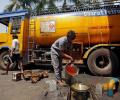
Investors shunned shares of oil marketing companies (OMCs) on Friday as they feared that the government's decision to cut retail prices of petrol and diesel could hurt the companies' profit margins in the near term. On Thursday, the government announced that OMCs will reduce pump prices of petrol and diesel after a record 22 months, making them cheaper by Rs 2 per litre in the national capital. The changes were effective from Friday.

Jet fuel (ATF) price on Tuesday was hiked by 4.2 per cent but that of commercial LPG used in non-residential establishments such as hotels and restaurants was cut by Rs 115.5 per 19-kg cylinder reflecting global energy trends. Aviation turbine fuel (ATF) price was hiked by Rs 4,842.37 per kilolitre, or 4.19 per cent, to Rs 120,362.64 per kl in the national capital, according to a price notification of state-owned fuel retailers. This reverses a 4.5 per cent cut in jet fuel prices affected last month.
From April 2020, manufacturers will have to hike prices of diesel cars sharply to accommodate the costs incurred in the transition to BS VI emission norms, and widening the gap between a diesel and petrol car.

India is back on the diplomatic table pushing oil producing countries to raise production in a bid to cool down runaway oil prices. Brent crude oil prices traded above $90 a barrel, on Thursday, for the first time since 2014. Brent is the most popular marker for crude oil trade. It is used as a benchmark for two-thirds of the world's internationally traded crude oil.

'Sometimes I wonder whether the meeting really happened. Everything seems like a dream from which I do not want to wake up.'
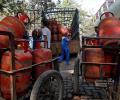
The government is likely to give a subsidy of Rs 30,000-35,000 crore to state-run oil companies - Indian Oil Corporation (IOC), Bharat Petroleum (BPCL), and Hindustan Petroleum (HPCL) - to compensate for losses incurred from selling LPG at below cost over the past 15 months, according to a senior official.
The auto industry, however, said any such step to impose additional taxes on the sector will not 'make sense'.
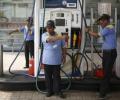
State-owned fuel retailers are losing close to Rs 3 per litre on selling diesel while the profit on petrol has trimmed due to recent firming up in international oil prices, industry officials said detailing reasons for continuing to hold retail prices. Indian Oil Corporation (IOC), Bharat Petroleum Corporation Ltd (BPCL) and Hindustan Petroleum Corporation Ltd (HPCL), who control roughly 90 per cent of India's fuel market, 'voluntarily' have not changed petrol, diesel and cooking gas (LPG) prices for almost two years now, resulting in losses when input cost was higher and profits when raw material prices were lower.
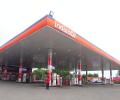
Petrol price on Monday neared Rs 100-a-litre mark in the national capital after the rate was hiked yet again. Petrol price was increased by 35 paise per litre while there was no change in diesel rates, according to a price notification from state-owned fuel retailers. In Delhi, the petrol price soared to Rs 99.86 per litre. Diesel rates were unchanged at Rs 89.36.

Dynamics of auto business will change if the government ends diesel subsidy to passenger vehicles.
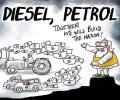
The government on Friday slapped an export tax on petrol, diesel and jet fuel (ATF) while also joining nations like the UK in imposing a windfall tax on crude oil produced locally. A Rs 6 per litre tax on export of petrol and ATF and Rs 13 per litre tax on export of diesel is effective from July 1, finance ministry notifications showed. Additionally, a Rs 23,250 per tonne tax was levied on crude oil produced domestically.

Profit on sale of diesel swelled to Rs 1.90 per litre as oil ministry awaits return of Prime Minister Narendra Modi to cut rates.
International crude oil prices may have eased but the government has no immediate plans to pass on the benefit to the consumers, as it wants to wait for the prices to stabilise further.
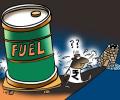
India's climate change goals are turning combustible. On the one hand, a protracted dispute between the government and manufacturers over subsidies threatens to slow the pace of electric vehicle (EV) sales. On the other hand, repeated assertions by different arms of the government over banning sales of new fossil fuel-fired vehicles have queered the pitch for energy investments. Before we address the issue of the recommended diesel vehicle ban in the recent report on energy transition, issued months before the next round of global climate talks begin in Dubai in November, let's look at what's at stake.

She charged the government with profiteering at the expense of the people, saying its duty was to help them in times of crisis and not make profits out of their hard-earned money.
The government has partially deregulated diesel price allowing a hike of 40-50 paise a litre per month for retail customers and nearly Rs 11 for bulk consumers, a step that is feared will have a cascading effect on inflation.

Oil marketing cos rightly passed on the burden to buyers.

The price of petrol is expected to come down to Rs 84.71 a litre and diesel to Rs 77.98
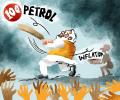
After premium petrol, the price of normal petrol has also crossed Rs 100 per litre in Rajasthan's Sriganganagar district.
The government will consider cutting petrol and diesel prices, if crude oil prices fall below $50 a barrel.
As crude oil prices hover around four-year lows, the government may look at slashing diesel prices further that will help cool inflation by lowering goods transportation charges.
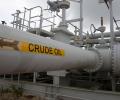
The government has slashed the windfall profit tax levied on domestically-produced crude oil as well as on export of diesel and ATF following a drop in global oil prices, according to an official order. The levy on crude oil produced by companies such as Oil and Natural Gas Corporation (ONGC) has been cut steeply to Rs 1,700 per tonne from Rs 4,900, the order dated December 15 said. Crude oil pumped out of the ground is refined and converted into fuel like petrol, diesel and aviation turbine fuel (ATF).
The government will cut petrol and diesel prices when there is a sustained drop in global crude oil prices, Petroleum Minister Murli Deora said on Thursday.

The loss, which is made good through government subsidy, has declined since March as the rupee strengthened against the dollar and global oil prices softened.

The price differential between diesel and petrol has narrowed. But there are still enough reasons to opt for the diesel variant.
State-owned oil companies on Wednesday raised the prices of petrol and diesel by Re 1 per litre each, effective from midnight.\n\n\n\n
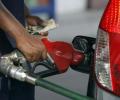
A looming global shortage of diesel in Europe presents India with more than one opportunity to profit from strong margins. A shortage of the fuel, a key contributor to inflation, has been exacerbated by the conflict in Ukraine, and western sanctions on Russian fuel supplies. The slowdown in natural gas supply means the West needs diesel to heat their homes this winter.
Petroleum Minister Murli Deora on Tuesday said petrol and diesel prices will not be increased "as of now" even as he began consultations with Finance Minister P Chidambaram on ways of mitigating the spurt in global oil prices.
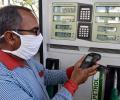
Petrol price on Thursday crossed the Rs 100-a-litre mark in Thane district of Maharashtra, while it was hovering a tad below that level in Mumbai, after fuel prices were raised again.

Petrol price has been cut by 58 paise a litre and diesel by 25 paise with effect from midnight tonight.
Excise duty on petrol will remain at Rs 14.35 a litre and diesel at Rs 4.60 per litre.
Prime Minister Manmohan Singh on Tuesday said that diesel prices too will be freed from government control as part of 'much-needed reforms', but LPG and kerosene will continue to be subsidised.

Technical Advisory Committee was for status quo in policy rate on little hope of government action.

From just 0.2 per cent before the Russia-Ukraine war to now accounting for 35-40 per cent of total crude imports, India's reliance on Russian oil has surged -- drawing fresh scrutiny with US President Donald Trump announcing a penalty on top of a 25 per cent tariff, or tax, on all goods going to the US.
Their first target would be bulk buyers.
Petroleum Minister Mani Shankar Aiyar on Tuesday hinted that the system of fortnightly revision of petrol and diesel prices is likely to be replaced with monthly or quarterly revisions.

Diesel prices are raised every month by up to 50 paise per litre to trim the losses. Rates were last raised on August 1 after which losses had dipped to Rs 1.33.
Petroleum Minister Murli Deora on Friday said the government would wait for international crude prices to stabilise before announcing any cuts in domestic petrol and diesel prices.
The share of diesel vehicles sold in 2014-15 was 37 per cent.
The government had in April 2002 freed petrol and diesel prices from administrative control, following which the state retailers revised prices every fortnight in line with changes in costs. But, controls were brought back in 2004 when crude oil rose to $37 a barrel and they have stayed high since then with crude oil soaring to an all-time high of $147 a barrel in July 2008.
